
Hon. Christine Boyle
Minister of Housing and Municipal Affairs
PO Box 9074, Stn Prov Govt
Victoria, BC V8W 9E2
Hon. Nina Krieger
Minister of Public Safety and Solicitor General
PO Box 9010, Stn Prov Govt
Victoria, BC V8W 9E2
SENT VIA EMAIL
RE: Provincial Coordination and Policy Reform to Ensure Eligible Electors in Custody Can Vote in the 2026 General Local Elections
Dear Ministers Boyle and Krieger,
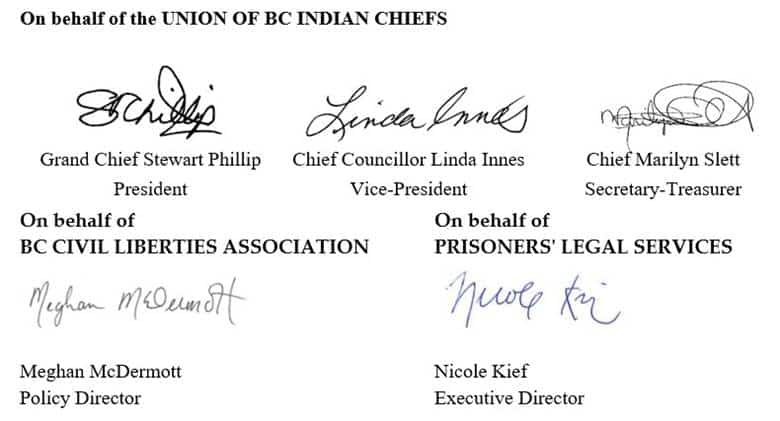
This is a joint letter from the Union of BC Indian Chiefs,[1] BC Civil Liberties Association[2] and Prisoners’ Legal Services.[3]
Brief Summary of Request
This request concerns more than election administration. At a time of low and uneven voter participation in BC, removing avoidable barriers faced by people who are legally entitled to vote is a concrete way to strengthen democratic participation, civic engagement and confidence in public institutions. Democracy is weakened when the law recognizes a person as an elector, but government systems make that right practically impossible to exercise. People in custody remain members of their communities, and local government decisions concerning housing, policing, education, public safety, accessibility and community services continue to affect them, their families and the communities to which they will return.
The issue is also inseparable from systemic racism and substantive equality. Indigenous and Black people are significantly overrepresented in correctional custody in BC. Systemic racism can persist through formally neutral policies and administrative practices that fail to account for unequal circumstances and thereby reproduce existing racial disadvantage. When correctional and election systems do not address the predictable barriers faced by people in custody, the resulting exclusion does not operate neutrally: it disproportionately affects communities already subject to systemic discrimination within public institutions. Ensuring meaningful voting access is therefore an important part of preventing public systems from perpetuating racial exclusion and civic marginalization.
This is not a request for special treatment. It is a request for fair, accessible and human rights-centred election planning that gives practical effect to voting rights the Legislature has already chosen to recognize. Because local elections are administered separately by numerous local governments and correctional centres hold electors from jurisdictions across the province, this is a systemic coordination problem that individual electors, correctional centres and local governments cannot reliably solve on their own.
Provincial leadership is needed to establish a consistent, rights-respecting approach across the province.
Provincial Leadership Is Needed Now
Low and uneven voter participation across all levels of government in BC is a major concern. Average municipal voter turnout in BC fell from 35.5% in 2018 to 29.2% in 2022, a decrease of 6.3 percentage points. [4] Turnout remained below 63% in every provincial general election held after 2001, with only 58.45% of registered voters casting a ballot in the 2024 provincial general election.[5] Federal voter turnout in B.C. similarly declined from 70.0% in 2015 to 66.0% in 2019 and 61.4% in 2021.[6] Although it rebounded to 69.2% in the 2025 federal general election, it remained below the 2015 level. Against this backdrop, removing avoidable barriers to voting is especially important.
The 2026 general local elections will be held on October 17. Unlike provincial elections, local elections are not administered by one central election body: each local government is responsible for running its own elections, including voting, counting, results, and nominations. BC Corrections operates 10 provincial correctional centres that house people awaiting trial and people serving provincial sentences of less than two years.
As part of our recent advocacy, we have reviewed publicly available election materials and sent correspondence to local governments and Chief Election Officers in host jurisdictions for provincial correctional centres (see Appendix for joint advocacy letters sent to local governments with correctional centres inside or near their land boundaries, and their Chief Election Officers).
That review has raised three systemic concerns.
First, publicly available election plans and election procedure bylaws we reviewed do not appear to show that relevant local governments or Chief Election Officers have planned voting access for eligible electors in custody at provincial correctional centres.
Second, we have not located publicly available BC Corrections materials explaining whether or how BC Corrections coordinates with local governments to support people in custody to exercise their local voting rights.
Third, the current decentralized framework makes access administratively complicated: electors in custody at a single correctional centre may be entitled to vote in many different municipalities, regional districts and school trustee electoral areas, depending on their ordinary residence and non-resident property elector status.
This complexity is not theoretical. Provincial correctional centres are located in Maple Ridge, Kamloops, Nanaimo, Port Coquitlam, Prince George, Saanich, Surrey, Fraser Valley Regional District Electoral Area E, and in an area that may be outside any municipal or regional district jurisdiction in the Okanagan-Similkameen region.
Two are particularly jurisdictionally complex: Xàws Schó:lha (formerly Ford Mountain Correctional Centre) is located on Chilliwack Lake Road in the Chilliwack River Valley, in a regional district electoral area rather than a municipality; Okanagan Correctional Centre has an Oliver address but is located north of Oliver on Osoyoos Indian Band land at Senkulmen Business Park.[7]
Eligible electors in these centres may nevertheless have voting rights related to local governments across British Columbia.
The result is a gap that individual local governments cannot solve alone. A host jurisdiction may be able to facilitate voting for its own electors in custody, but it cannot issue ballots for every municipality, regional district electoral area, or school trustee election in which detained electors may be eligible to vote. Provincial coordination is therefore essential.
Eligible Electors in Custody Remain Local Electors
Not all people in correctional custody are disqualified from voting in local elections. People in pre-trial custody, also known as people on remand, and people serving sentences that do not disqualify them remain entitled to vote if they otherwise meet the statutory requirements for resident or non-resident property electors.[8] The Local Government Act also recognizes that temporary absence does not end a person’s residence.[9]
The elector status of some people in custody is a deliberate feature of BC’s electoral framework, with the entitlements from the Local Government Act reflected in the Vancouver Charter and extended to local trustee elections under the Islands Trusts Act.[10]
These electors remain members of local communities. Local elections shape housing, public safety, education, policing, accessibility, emergency response, community services, and reintegration supports. These decisions continue to affect people in custody, their families, their children, and the communities to which they will return.
Voting Access Benefits Democracy, Reintegration, and Public Safety
Facilitating voting for eligible electors in custody strengthens democratic legitimacy, reinforces respect for the rule of law, and treats people in custody as continuing community members with civic responsibilities.
The Supreme Court of Canada’s decision in Sauve v. Canada (Chief Electoral Officer) concerned federal voting rights under section 3 of the Charter, not local statutory voting rights, and the Court has since confirmed that section 3 does not itself extend to municipal councils. However, Sauve remains relevant to voting rights the Legislature has chosen to provide. The Court recognized that disenfranchisement contradicts the message that everyone is equally worthy under the law and is more likely to erode respect for the rule of law and rehabilitation than to advance them.[11] Local election law, correctional policy, resourcing, and administrative practice should not reduce a statutory voting right to a theoretical one.
Voting access in secure and institutional environments is practical and possible. Elections Canada has established special ballot procedures for incarcerated electors, including institutional liaison officers who help eligible electors register and vote.[12] A recent Senate report describes institutional voting processes that include notices, registration and special ballot applications, liaison officers, election officers, and mobile polling where needed.[13] Elections BC also recognizes special voting as a flexible tool for voters who face barriers to ordinary voting opportunities.[14]
Opportunity to Advance Racial Equity and Human Rights
Failing to provide voting access for eligible electors in custody also reinforces systemic racism in local democracy and public policy across BC. Your government’s anti-racism resource defines systemic racism something that “[o]ccurs through inequities that are built into services, systems and structures. These are often caused by hidden biases that disadvantage people based on their race.”[15] Here, the pattern is clear: Indigenous and Black people are significantly overrepresented in correctional custody, while local elections determine representation in institutions that shape policing, education, housing, local services, and community safety.
BC Corrections reports that Indigenous people are nearly 6% of BC’s adult population but 36% of individuals in custody. Recent Statistics Canada data shows that, in BC, Indigenous adults were incarcerated at 9.4 times the rate of non-Indigenous adults, and Black adults were incarcerated at 2.1 times the rate of white adults.[16]
Canada’s Black Justice Strategy reinforces that this is not only a corrections issue, but a democratic and public-institution issue. Its Roadmap links policing, courts, corrections, reintegration, and social determinants of justice, and recognizes the need for municipal collaboration in areas such as policing, social determinants of justice, and supports for people leaving custody.[17]
Human rights complaints and settlements have also treated inaccessible voting as discrimination, including barriers to voting in municipal elections.[18] The same principle should guide access to voting for people in custody: eligible electors should be able to participate with dignity, secrecy, and meaningful access.
BC’s Framework Creates Severe Jurisdictional Gaps
The Local Government Act gives local governments important tools, including additional general voting opportunities, additional advance voting opportunities, special voting opportunities for electors who may otherwise be unable to vote, and mail ballot voting with related registration procedures.[19] A special voting opportunity may also be held outside municipal or electoral area boundaries, a crucial feature to support local governments and their appointed Chief Election Officers in making voting accessible in BC’s Correctional Centres.[20]
Those tools are important, but the current model appears to leave each local government and Chief Election Officer to act on their own initiative. That creates a predictable risk that eligible electors in custody will fall through jurisdictional gaps.
To illustrate the presumed difficulty in coordination, people in custody at Prince George Regional Correctional Centre may have voting rights in Prince George, the Regional District of Fraser-Fort George, Quesnel, Vanderhoof, Mackenzie, Fort St. John, Dawson Creek, or other northern BC jurisdictions, depending on their ordinary residence or non-resident property elector status. A person held at Xàws Schó:lha Correctional Centre or Okanagan Correctional Centre may be held outside an ordinary municipal host context altogether, while retaining voting rights elsewhere.
Local governments can and should use their powers to facilitate voting for eligible electors in custody. However, local governments cannot coordinate access across the entire provincial corrections system on their own. Without provincial guidance, BC Corrections operational support, and clear expectations for local election administrators, the practical burden falls on individual people in custody to identify their rights, obtain information, register, request a ballot, meet deadlines, and return a ballot while detained.
The Special Ballot Voting Gap for Electors in Custody
Even when special ballot voting is available, procedural barriers may prevent eligible voters in custody from successfully casting a valid ballot. In the 2015 federal election, voters in custody cast 22,362 special ballots, of which 1,689 or 7.5% were rejected.[21] In comparison, fewer than 2% of the 556,191 special ballots cast by the general population were rejected. This substantial disparity suggests that incarcerated voters face distinct procedural and administrative barriers. Without deliberate measures to address these barriers, they risk being reproduced in the upcoming 2026 election.
Accessible Voting in Custody Is Feasible and Already Contemplated Elsewhere
BC and other jurisdictions have already recognized that ordinary voting processes may need to be tailored for electors facing physical, institutional, or access-related barriers.
Manitoba’s Municipal Councils and School Boards Elections Act expressly permits a Senior Election Official to establish mobile voting stations to serve eligible voters of a local authority who are detained in a remand facility or who are geographically dispersed. Manitoba’s 2026 Election Officials Manual similarly describes mobile voting stations for voters detained at a remand centre or otherwise unable to attend ordinary voting opportunities.[22]
BC’s own Local Government Act already tailors voting procedures where ordinary access to a voting place is not possible. Section 132 provides a procedure for an elector who comes to a voting place but is unable to enter because of physical disability or impaired mobility, allowing election officials to attend the elector at the nearest accessible location and protect ballot secrecy.[23] That provision is not a complete answer for people in custody, who cannot simply attend a voting place, but it shows that BC local election law already recognizes the need to adapt voting procedures where ordinary access barriers would otherwise prevent participation.
Residence and Address Rules Require Provincial Clarification
In addition to the core physical barrier created by custody, there are unresolved questions about how local election residence rules apply in correctional settings. The Local Government Act provides that temporary absence does not end a person’s residence, but it is not clear from publicly available materials how local election administrators and BC Corrections are expected to help electors in custody apply those rules in practice.[24]
There may also be people in custody who cannot identify or document a prior ordinary residence, who have experienced homelessness, who have lost housing during custody, or who have no safe family address to use. A recent Senate report on federal prison voting identified similar concerns and recommended amending federal election law so incarcerated electors may use their correctional institution as their address for voting purposes, noting that the existing prohibition can create barriers for people who cannot recall or use a previous address.[25]
We ask the Province to clarify whether, under BC local election law, eligible electors in custody may rely on temporary absence rules, prior residence, non-resident property elector status, and/or the correctional centre address in any circumstances related to their right to vote in genera local government elections. If the current statute does not provide a clear and rights-respecting answer, law reform should be considered as soon as possible, to ensure that future local government elections include electors in custody.
We respectfully ask your ministries to:
- Confirm whether BC Corrections has a province-wide program, policy, protocol, or operational plan to support voting by eligible electors in custody in the October 17, 2026 general local elections, or whether any current support is ad hoc by facility. Similar confirmation for general provincial and general federal elections is also requested.
- Confirm whether your ministries consider legislative or regulatory reform necessary to ensure eligible electors in custody can meaningfully vote in general local elections, including reforms to clarify residence/address rules and to enable coordinated voting access across local jurisdictions.
- If your position is that existing law is sufficient, commit to providing the resources, direction, and intergovernmental coordination needed so local governments and Chief Election Officers are not left to address this issue independently.
- Direct or support BC Corrections to coordinate with local governments, Chief Election Officers, school trustee election administrators, and correctional centre wardens to provide timely voter information, registration assistance, mail ballot support, secure ballot-return procedures, ballot secrecy protections, and access for election officials where required.
- Develop and publish plain-language guidance for people in custody, correctional staff, local election administrators, candidates, and the public explaining who may vote, how residence rules apply, how mail ballot and special voting processes can be used, and where questions should be directed.
- Work with local governments and other public officials and institutions as appropriate to identify and implement a consistent province-wide approach before key 2026 election deadlines.
- Provide a written response outlining the steps your ministries will take to ensure eligible electors in custody can exercise their local voting rights in the 2026 general local elections and future elections, including the 2030 general elections and the byelections that will occur in between.
Summary and Request for Response
Eligible electors in custody remain members of local communities. Because local governments shape systems affecting families, reintegration, rights, and racial equity, failing to plan for correctional centre voting access would not operate neutrally. It would predictably exclude people who face state-created barriers to ordinary voting and who are disproportionately affected by systemic discrimination in the criminal justice system.
We ask your ministries to treat this access as a necessary measure of fair, accessible, human rights-centred election law and correctional administration. Local governments and Chief Election Officers have important responsibilities, but they should not be left to solve a provincial coordination problem on their own. Provincial leadership is needed now to ensure that all legally qualified electors have a meaningful opportunity to vote in the October 17, 2026 general local elections.
Sincerely,
CC: Hon. Niki Sharma, BC Attorney General
Hon. Brittny Anderson, BC Minister of State for Local Governments and Rural Communities
Hon. Terry Yung, BC Minister of State for Community Safety and Integrated Services
Amna Shah, BC Parliamentary Secretary for Anti-Racism Initiatives
Haiqa Cheema, Assistant Deputy Minister (Multiculturalism and Anti-Racism), BC Ministry of Attorney General
Doug Forsdick, Provincial Director, BC Corrections
Lisa Romanuik, Director of the Investigation and Standards Office, BC Corrections
Kasari Govender, K.C., Human Rights Commissioner for British Columbia,
Shipra Verma, Chief Electoral Officer of British Columbia, Elections BC
Appendix sent via separate attachment to email, including the following:
Ltr to Chilliwack Council July 17 2026
Ltr to Chilliwack CEO July 17 2026
Ltr to FVRD Board July 17 2026
Ltr to FVRD CEO July 17 2026
Ltr to Kamloops CEO July 17 2026
Ltr to Kamloops City Council July 17 2026
Ltr to Maple Ridge CEO July 17 2026
Ltr to Maple Ridge Council July 17 2026
Ltr to Nanaimo CEO July 17 2026
Ltr to Nanaimo City Council July 17 2026
Ltr to Oliver CEO July 17 2026
Ltr to Oliver Council July 17 2026
Ltr to Port Coquitlam CEO July 17 2026
Ltr to Port Coquitlam Council July 17 2026
Ltr to Prince George CEO July 17 2026
Ltr to Prince George Council July 17 2026
Ltr to RDOS Board July 17 2026
Ltr to RDOS CEO July 17 2026
Ltr to Saanich CEO July 17 2026
Ltr to Saanich Council July 17 2026
Ltr to Surrey CEO July 17 2026
Ltr to Surrey City Council July 17 2026
[1] The UBCIC is a First Nations political advocacy organization founded in 1969 with a mandate of advancing and protecting First Nations title and rights. The UBCIC strengthens First Nations’ assertions of their title, rights, treaty rights and right of self determination as peoples, working collectively among First Nations in B.C. as a cohesive advocacy body. https://www.ubcic.bc.ca/
[2] BC Civil Liberties Association works to promote, defend, sustain, and extend civil liberties and human rights in British Columbia and Canada, including through law reform, public legal education, and systemic advocacy. https://bccla.org/
[3] Prisoners’ Legal Services provides legal assistance to people incarcerated in federal and provincial prisons in British Columbia and advocates on prison justice issues affecting the rights, dignity, and legal protections of people in custody. https://prisonjustice.org/about/services-offered/
[4] CivicInfo BC, “2018 Voter Turnout Municipalities,” and “2022 Voter Turnout Municipalities,” accessed July 16, 2026, https://www.civicinfo.bc.ca/electionreports/voter-turnout.php?year=2018 and https://www.civicinfo.bc.ca/electionreports/voter-turnout.php?year=2022. The 6.3-percentage-point decrease is the calculation of this letter’s authors.
[5] Elections BC, “Voter Turnout,” General Elections table. Elections BC reported turnout of 62.36% in 2005, 55.14% in 2009, 57.10% in 2013, 61.18% in 2017, 53.86% in 2020, and 58.45% in 2024.
[6] Elections Canada, Official Voting Results: Forty-Fifth General Election 2025, “Voter Turnout for the 2025, 2021, 2019 and 2015 General Elections,” https://www.elections.ca/res/rep/off/ovrGE45/62/table4E.html.
[7] Province of British Columbia, “Correctional centres,” https://www2.gov.bc.ca/gov/content/justice/criminal-justice/corrections/correctional-centres; Fraser Valley Regional District, “Electoral Area E,” https://www.fvrd.ca/EN/main/about-the-fvrd/electoral-areas/electoral-area-e.html; Infrastructure BC, “Okanagan Correctional Centre Project,” https://www.infrastructurebc.com/project/okanagan-correctional-centre-project/.
[8] Local Government Act, RSBC 2015, c 1, ss 64-66. Section 64(2)(b) disqualifies a person who is in custody and has not completed the sentence for an indictable offence, unless the person is released on probation or parole and is not in custody. People in pre-trial custody and people serving sentences that are not captured by this disqualification may vote if they otherwise meet the statutory qualifications.
[9] Local Government Act, RSBC 2015, c 1, ss 64-67.
[10] Vancouver Charter SBC 1953 c 55 s 22.; Islands Trust Act RSBC 1996 c 239 s.6(3).
[11] Sauve v Canada (Chief Electoral Officer), 2002 SCC 68, [2002] 3 SCR 519 at paras 38-41, 58-60; Toronto (City) v Ontario (Attorney General), 2021 SCC 34 at paras 80-81.
[12] Elections Canada, “Voting by Incarcerated Electors”, https://www.elections.ca/content.aspx?dir=bkg&document=ec90545&lang=e§ion=vot.
[13] Senator Bernadette Clement, Ballots Behind Bars: Voting in Federal Elections from Canada’s Prisons (June 20, 2025), pp 7-9, https://sencanada.ca/media/snofsb5f/en-report-ballots-behind-bars_2025-06-20.pdf.
[14] Elections BC, “Special voting,” https://elections.bc.ca/docs/8030076-PRS-Special-voting.pdf.
[15] British Columbia, “Anti-Racism Definitions,” https://www2.gov.bc.ca/gov/content/governments/multiculturalism-anti-racism/anti-racism/anti-racism-definitions.
[16] Province of British Columbia, “BC Corrections and Indigenous justice” (last updated November 19, 2024), https://www2.gov.bc.ca/gov/content/justice/criminal-justice/corrections/reducing-reoffending/indigenous; Statistics Canada, “Overrepresentation of Indigenous and Black adults in provincial and federal custody,” The Daily (January 14, 2026), https://www150.statcan.gc.ca/n1/daily-quotidien/260114/dq260114b-eng.htm.
[17] Department of Justice Canada, Canada’s Black Justice Strategy (last modified May 22, 2026), https://www.justice.gc.ca/eng/cj-jp/cbjs-scjn/index.html; Akwasi Owusu-Bempah and Zilla Jones, A Roadmap for Transformative Change: Canada’s Black Justice Strategy (Department of Justice Canada, June 2024), Executive Summary, “Five Priority Areas,” and “Guiding principles,” https://www.justice.gc.ca/eng/cj-jp/cbjs-scjn/transformative-transformateur/index.html.
[18] Ontario Human Rights Commission, “Access of persons with disabilities to secret vote reaffirmed in human rights settlement” (June 12, 2002), https://www.ohrc.on.ca/en/news-center/access-persons-disabilities-secret-vote-reaffirmed-human-rights-settlement; Canadian Human Rights Tribunal, Hughes v Elections Canada, 2010 CHRT 4.
[19] Local Government Act, RSBC 2015, c 1, ss 106-110.
[20] Local Government Act, RSBC 2015, c 1, s 109(5).
[21] Elections Canada, Report on the 42nd General Election of October 19, 2015, (February 3, 2016), p. 56, online(pdf): https://publications.gc.ca/collections/collection_2016/elections/SE1-1-1-2015-eng.pdf
[22] Municipal Councils and School Boards Elections Act, CCSM c M257, s 94(2); Manitoba Municipal Relations and Northern Relations, 2026 Election Officials Manual, “Mobile voting stations,” https://www.gov.mb.ca/mr/mfas/pubs/election_officials_manual.pdf.
[23] Local Government Act, RSBC 2015, c 1, s 132.
[24] Local Government Act, RSBC 2015, c 1, ss 64-67.
[25] Senator Bernadette Clement, Ballots Behind Bars: Voting in Federal Elections from Canada’s Prisons (June 20, 2025), pp 18-19 and Recommendation 2, https://sencanada.ca/media/snofsb5f/en-report-ballots-behind-bars_2025-06-20.pdf.